
To Meet Uncertainty and Complexity, Try Humility and Boredom

Uncertainty/Complexity “We humans, facing limits of knowledge, and things we do not observe, the unseen and the unknown, resolve the tension by squeezing life and the world into crisp commoditized ideas.”
-Nassim Nicholas Taleb (Author of The Black Swan)
Humility: “There are two types of people in the world: you are either humble… or about to be humble.”
- A directive from the coach of the Vanderbilt University men’s basketball team, now surpassing expectations.
Boredom: In a study asking people to do nothing for 15 minutes, 67% of men and 26% of women chose to push a button to shock themselves instead of experiencing boredom.
- Study published in Science Magazine
The Practice of Boredom and Humility
Half Day Retreat
A Poem by Rilke
What I’m Reading
It’s easy to be overwhelmed by uncertainty and complexity. Or as Nassim Nicholas Taleb asserts, to avoid complexity by oversimplifying, narrowing our lives, or thinking that we either understand what is happening or that we can predict the future by looking at the past.
When it comes to predicting the future, I like to give the examples that predicting Obama as president would have been nearly impossible, and the same for Trump. Really, how could this be? Unthinkable! This is true of nearly all major events, and is equally true when we step back and look at our own lives. (For example, how did a quiet kid who grew up in the suburbs of central New Jersey end up living 10 years at the San Francisco Zen Center and then work in the realm of mindful leadership??)
Given the nature of our amazingly uncertain and complex world and our inability to predict the future, a dose of humility and boredom may be two important and useful practices.
Humility. I like the quote by the Vanderbilt coach. “There are two types of people in the world: you are either humble… or about to be humble.” Humility has a way of cutting through complexity and connecting us to each other. No one really knows or understands very much - how we got here or where we are going.
A core teaching of the historical Buddha - the facing of old age, sickness, and death - is quite humbling. As is the insight that everything - our bodies and minds, the air we breathe, have all been given to us. Again, humbling. There is a stark truth to the statement that if you are not humble, you will be. So, why not start now… To me humility feels like beginner’s mind, not being an expert, and just paying more attention to what is. And, that we are all in the same humble boat, regardless of the outer trappings.
Boredom can be a practiced and these days needs to be practiced. It means to put down or put away our phones, turn off our computers, and just be with ourselves or others without all the noise and distractions. The Science study is funny and also depressing, that when asked to do nothing, people would rather shock themselves than just be with themselves without distraction.
Practices:
Humility - There was a Zen teacher who’s core teaching was “Just don’t know” - letting go not only of being right, but also letting go of what we think or believe we know. Exploring less knowing and more humble curiosity.
Boredom - I just spent six days at Tassajara without looking at at a phone or computer. How refreshing! It takes some planning and structure but is worth it — no phones at meals, no phones after a certain hour in the evening. Explore what it feels like to be bored, and see what emerges. A little discomfort can yield unexpected feelings and insights.
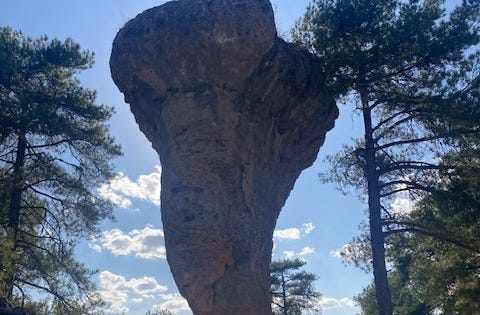
Meditation practice can be described as the practice of humility and boredom -- not knowing what will happen and letting go, as much as possible of all distractions. Or as one of my teachers suggests - “just go sit on a rock.” No fancy cushions are required.
Half Day Retreat, Sunday, January 11th, In-person (Mill Valley) and Online
In our world of busyness, of more/faster/better, this half-day retreat offers time to stop, reflect, and renew. We’ll follow a gentle schedule of sitting and walking meditation, a talk, and some discussion. Anyone looking to begin or deepen a meditation and mindfulness practice is invited to attend. What is meditation? I like a definition proposed by Dogen, the 13th century founder of Zen in Japan: “The practice I speak of is not meditation. It is simply the dharma gate of repose and bliss…It is the manifestation of ultimate reality…Once its heart is grasped, you are like a dragon when he gains the water, like a tiger when she enters the mountains.”
A Poem by Rilke
Sometimes a Man Stands Up During Supper
Sometimes a man stands up during supper
and walks outdoors, and keeps on walking,
because of a church that stands somewhere in the East.
And his children say blessings on him as if he were dead.
And another man, who remains inside his own house,
dies there, inside the dishes and in the glasses,
so that his children have to go far out into the world
toward that same church, which he forgot.
What I’m Reading
Simple Habits for Complex Times, by Jennifer Garvey Berger and Keith Johnston. A book for leaders or anyone. Ideas and practices for navigating change.
The Black Swan, by Nassim Nicholas Taleb. A bestseller from 2010 exploring the paradox of complexity and prediction.
Warmest regards,
Marc